“constrFields” runtime error message using HStringTemplate
This post is one for the Google spider so that if somebody else has this problem they can find the solution by searching (I haven’t found mention of it anywhere else on the web).
If you are using HStringTemplate (version 0.6.3 at least) in Haskell and your program is failing at runtime with the not-particularly-informative message "constrFields", you might wonder what the problem is. This message is generated by the SYB library used in the implementation of Text.StringTemplate.GenericStandard. The error is caused by attempting to access a constructor for a primitive type.
Why is HStringTemplate doing this? Looking at the HStringTemplate source we can see that it does not currently support generation of generic ToSElem instances for records that have fields of type Char. At the moment, the simplest solution to this problem is to change your Char fields into Strings.
Announcing stats.footballpredictions.net
A long time ago I wrote a brief round-up of the options for generating HTML output from Haskell. The reason I was looking into this at that time was because, as an exercise to learn more about programming in Haskell, I was attempting to replicate the functionality of my Football Statistics Applet (FSA) but with pure HTML output rather than a heavyweight interactive Java applet.
The result of this effort was a Haskell program I call Anorak, the vast majority of which I wrote quite a while ago (it’s not going to win any prizes for beautiful Haskell code). It processes FSA data files and, using HStringTemplate, generates static HTML pages containing league tables, form tables, sequences and more.
Having left Anorak dormant for months, yesterday I tidied up a few rough edges and created stats.footballpredictions.net. This online resource provides current and archive statistics for the main football leagues in England, including an all-time Premier League table that incorporates the result of every match played since 1992. I also intend to include all of the main Scottish divisions soon but the Scottish Premier League has a bizarre split structure that, though supported by FSA, is not yet supported by Anorak. Other European leagues (Serie A, La Liga, Bundesliga) will follow some time in the future.
Update: Anorak has been updated to deal with the SPL-style split format and the site has now been expanded to include the SPL and all divisions of the Scottish Football League.
Haskell’s New Logo
The competition to find a new logo for the Haskell programming language has a winner:

I’m not sure if this is the final choice as the competition page mentions it won the “first round” of voting. The colour scheme is a bit conservative but, other than that, I like it. It’s an improvement on the rather cluttered previous logo:

Generating HTML with Haskell
If you want to generate HTML pages from Haskell, there are a few different approaches available. The Haskell.org wiki lists several web-related libraries.
Text.Html
The standard Haskell libraries include the Text.Html module. This is a combinator library that allows you to generate HTML pages by combining Haskell functions. Each function is responsible for generating an HTML fragment and these fragments are combined to construct a complete page. Haskell’s static type-checking ensures that the output is well-formed (though not necessarily valid).
By arranging your code appropriately, you can achieve a satisfactory separation of presentation and logic, but I’m not comfortable with this approach. The combinator idea works excellently for implementing parsers with Parsec but, in my opinion, is not such a good fit for generating web pages. It reminds me a little bit of the dark age of Java web development when pages were generated by servlets concatenating Strings of HTML tags. The combinator approach is more elegant than the unchecked concatenation of Strings in Java, but it’s still an attempt to internalise HTML. I’d rather write my HTML in HTML than in Haskell (or Java), particularly for complex pages with CSS and JavaScript involved.
WASH/HTML
WASH/HTML is another implementation of the combinator approach. It guarantees both well-formedness and validity of its HTML 4.0.1 output. WASH stands for Web Authoring System Haskell. WASH provides a complete Haskell web stack, of which WASH/HTML is a part. With WASH/HTML, a simple Hello World page is generated using the following code:
build_document (head (title (text "Hello World!")) ## body (h1 (text "Hello World!")))
Haskell Server Pages
Haskell Server Pages (HSP) brings the ASP/JSP/PHP model to Haskell. In other words, it mixes presentation mark-up with computations. There are a some minor differences in the Haskell implementation of this idea compared to the imperative variants. Perhaps most interestingly, all XML fragments are actually Haskell expressions, which allows the type-checker to enforce well-formedness. Using HSP, an HTML page can be expressed as a Haskell function as follows (where helloWorld is another function that generates the text content for the page):
page = <html> <head><title>Hello World!</title></head> <body><p><% helloWorld %></p></body> </html>
This is a lot closer to pure HTML than the combinator libraries. HSP also supports the concept of XML pages and hybrid pages, so instead we can create an actual HTML document that includes Haskell code fragments:
<% import System.Time %>
<html>
<head><title>XML page</title></head>
<body>
<h1>Hello World!</h1>
<p>Page requested at <% getSystemTime %></p>
</body>
</html>HSP has roughly the same high-level benefits and drawbacks as JSP and PHP. These technologies give you a lot of power but they can also lead you astray. It takes discipline to maintain a clean separation between logic and presentation. Since HSP permits (requires) side-effects, there’s nothing to stop you from doing truly ugly things such as embedding database update logic in the code that generates your HTML pages.
HStringTemplate
HStringTemplate is a Haskell port of Terence Parr’s StringTemplate engine (originally for Java but also available for C# and Python). StringTemplate is a templating engine along the lines of Apache Velocity but is more restrictive in what processing it permits templates to perform. Specifically, it strictly enforces separation between model and view. It is not possible for a template to cause side-effects elsewhere (no database updates, etc.). StringTemplate can be used for generating any kind of text output, not just XML/HTML. In fact, one of its principal uses is as a code generator for ANTLR.
I have chosen to use HStringTemplate, in preference to the alternatives described above, for my current Haskell project.
A StringTemplate template for an HTML page looks something like this (the StringTemplate website provides more details of the kinds of expressions that can be used):
<html> <head><title>Hello</title></head> <body><p>Hello $name$</p></body> </html>
To convert this into an HTML page, the template must be parsed, a value assigned to the “name” attribute, and the HTML rendered to a file. The Haskell code to do this might look like this (see the Haddock documentation for descriptions of the various functions):
import Text.StringTemplate main = do templateText <- readFile "templateFile" template = newSTMP templateText writeFile "outputFile" html where html = toString $ setAttribute "name" "Dan" template
This is only a very simple example. The StringTemplate template language provides facilities for working with lists and maps, and for recursion and basic conditionals. HStringTemplate defines the type class ToSElem for mapping custom data types to types that can be inserted into a template.
I have found that HStringTemplate works very well. It allows me to keep my HTML source separate from my Haskell code. The only criticism I have is that the conditionals are not very expressive. An “if” statement in a template can only check whether a particular attribute is set or unset, or whether a boolean is true or false. The particular problem that I had was that I wanted to apply different formatting depending on whether a value was positive or negative. There was no straightforward way to do this. Instead I had to insert a separate pre-evaluated boolean attribute, isNegative, into the template and check that. This appears to be a (deliberate) limitation of all StringTemplate variants, not just the Haskell version.
Installing GHC 6.10.1 on OS X 10.4
Every time I need/decide to upgrade GHC, it seems there’s a different set of hoops I need to jump through to get it working on OS X 10.4 (Tiger). I don’t have OS X 10.5 (Leopard) and I don’t intend to buy it, so unfortunately I don’t get to use the nice-and-simple installer. I’ve decided to write down the exact steps that I’m taking this time so that I have a reference if I need to do it again (or if somebody else needs to do the same).
I’m pretty certain that this isn’t the way I did it last time. I seem to recall manually building the whole thing from a source tarball and having to resolve the dependencies myself. Then again, that’s probably why I have to upgrade now – my 6.8.2 install appears to be broken.
MacPorts and Xcode
The GHC site recommends that Tiger users use MacPorts, so that’s what I’m doing. I would have used fink, because I already have that set-up, but they don’t have a recent GHC build available for Tiger (6.6.2 is relatively ancient).
First I tried to install MacPorts without upgrading Xcode. It hung. So then I did what I had been told (and had ignored) and downloaded the latest version of Xcode from the Apple Developer Connection. For Tiger the latest version is 2.5. 3.0 and above are for Leopard only. At 903mb the download is not exactly slimline. After running the Xcode installer the MacPorts installer worked properly, which was nice.
Installing GHC from MacPorts
After that, it’s supposed to be easy:
$ sudo port install ghc Password: sudo: port: command not found
MacPorts installs to /opt/local and I didn’t have /opt/local/bin on the path (it seems that the “postflight script” mentioned here didn’t run or didn’t work). No problem:
$ sudo /opt/local/bin/port install ghc
This is meant to download, build and install the latest GHC and all its dependenices (GMP, yet another version of Perl, etc.). After some time had elapsed my first attempt failed with this helpful message:
Error: Status 1 encountered during processing.
The GCC output seemed to suggest that it couldn’t find the GMP library that MacPorts had just installed. Google revealed this to be a bug in the Portfile. Somebody else had run into the same problem earlier the same day and the maintainer was on the case. After leaving it for a day, the bug is now fixed and I tried again. This time the installation proceeded without problems, although it took a fecking long time to complete.
Paths and Symlinks
Once the install was done, I removed all traces of the previous 6.8.2 install (which was under /usr/local) and made sure that /opt/local/bin was on my path (in ~/.bash_login).
$ ghc --version The Glorious Glasgow Haskell Compilation System, version 6.10.1
Excellent. The thing that prompted me to upgrade was that Haddock wasn’t working for me since I upgraded it to the latest version. So that was the next thing to check:
$ ./setup.hs haddock setup.hs: haddock version >=0.6 is required but it could not be found.
It seems that for this particular build of GHC the Haddock executable is called haddock-ghc, rather than haddock as in 6.8.2. Cabal is still looking for haddock though, so I added a symlink and everything was fine again:
$ sudo ln -s /opt/local/bin/haddock-ghc /opt/local/bin/haddock
I think I now have a working GHC 6.10.1 installation.
Real World Haskell
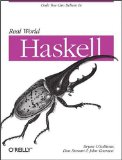
The book Real World Haskell by Bryan O’Sullivan, Don Stewart, and John Goerzen, will be available to buy from November.
The content is also freely available online already and is well worth a look if, like me, you are keen to learn more about developing actual useful programs with Haskell.
I first mentioned Real World Haskell last year. At the time I also highlighted GHC’s LGPL problems as an obstacle that could potentially discourage the wider adoption of Haskell. It seems that some progress is being made on that front. At present though, GHC will still statically link to GMP, which means that developers who distribute GHC-compiled binaries are distributing “derivative works” as defined by the LGPL.
Revisiting the Comments Debate: The Self-Documenting Code Contest
The great commenting debate generated a lot of disagreement, both here and elsewhere, about the value of code comments with respect to writing self-explanatory code. If you are of the opinion that good code does not need comments, here is your chance to prove it. Laurie Cheers has created The Self-Documenting Code Contest. The idea is to solve a given problem using the most understandabe code that you can write. No comments are allowed. The problem is to generate all two-word anagrams of the word “documenting”.
Although I’ve clearly stated my opinion in favour of comments, I decided to give it a shot. I’ve already submitted my Haskell solution and, to be honest, you’d do well to improve on its readability. I believe that it satisfies all of the requirements using a brilliantly simple algorithm.
I’ve hidden my code in case you want to try for yourself first. Click “show” to reveal my solution: show
UPDATE: I got disqualified from the contest for “being a smartass”
Cedric’s Coding Challenge
Cedric Beust has posted a programming challenge on his blog. Seeing as I have nothing better to do, I thought I’d give it a go in Haskell. Here is a naive brute-force solution that I came up with. I’m sure there are many optimisations that can be made.
import List(nub) -- Predicate that returns True if a number contains no duplicate digits. noDuplicateDigits :: Int -> Bool noDuplicateDigits n = length (nub (digits)) == length digits where digits = show n values :: Int -> [Int] values n = [x | x <- [1..n], noDuplicateDigits x] -- Given a positive integer n, return the number of values between 1 and n that -- contain no duplicate digits, and the largest gap between two consecutive -- values in that sequence. answer :: Int -> (Int, Int) answer n = (length sequence, gap) where sequence = values n gap = maximum (zipWith subtract sequence (tail sequence))
Useful Haskell Links
Tutorials
- Yet Another Haskell Tutorial (PDF) – by Hal Daume III
- A Gentle Introduction to Haskell – by Paul Hudak, John Peterson and Joseph Fasel
- Learn Haskell in 10 Minutes
- Haskell Tutorial – Walla Walla College Computer Science Department
- A Taste of Haskell (PDF) – Slides from Simon Peyton-Jones’ OSCON tutorial sessions (video: part 1 and part 2).
- Tackling the awkward squad: monadic input/output, concurrency, exceptions, and foreign-language calls in Haskell (PDF) – by Simon Peyton-Jones
Specifications
Books
Compilers and Interpreters
Monads
- You Could Have Invented Monads!
- Monads: A (hopefully) painless introduction
- What the hell are Monads?
Software Transactional Memory
- Beautiful Concurrency (PDF) by Simon Peyton-Jones (from the book Beautiful Code
).
- Transactional Memory for Concurrent Programming (16 minute video) – An OSCON presentation by Simon Peyton-Jones (PDF slides)
Haskell – Ready for the mainstream?
Having been exposed to pure functional programming in Miranda at university, Haskell is a programming language that I like a lot. I’ve dabbled with it on and off using GHC but I’ve never written a really substantial program in it. Certainly nothing to rival the Java behemoths that I develop day-to-day. Programs written (well) in Haskell are concise, expressive and have an elegance that is hard to match in more general-purpose languages such as C and Java.
Despite the appeals of strongly-typed, side-effect-free programming, Haskell (and non-strict, pure functional languages in general), have long been regarded as primarily the domain of academics. Haskell’s design owes much to the proprietary Miranda system but, unencumbered by commercial constraints, it has rapidly supplanted its predecessor. Even the University of Kent, previously the principal champion of Miranda, has long since switched to Haskell for teaching purposes. Haskell is now a part of undergraduate computer science courses around the world but, despite this, has little visibility in the world of commercial software development.
However, all that may be about to change. This week saw the announcement of the book “Real World Haskell”, to be published by O’Reilly. If the authors deliver on the proposed outline, it promises to provide a real boost for Haskell as a viable language for mainstream software development. The book will cover topics that are often ignored by existing Haskell guides but that are essential for solving real world problems. I/O, databases, GUI development, concurrency and unit testing are just some of the items to be addressed.
At present there is nothing much to see, but I’ll be monitoring their progress closely over the coming months in eager anticipation. Hopefully, by the time the book is out, GHC will have broken free from its LGPL shackles to remove another barrier to widespread Haskell adoption.


